Two of the main motivators for a dog is food and sex, this is why we make use of food to help train our dogs – its easy to use and has also been scientifically proven that is works effectively!
It’s important to think about what treats you use whilst you are training your dog. If you think of treats as money, would you go to work and do your job for free? All you are doing by using treats to train your dog, is paying them for doing their job!
If you are training a new command, you will want to use a treat that is of high value to your dog, as they will work harder for it. Once your dog understands a command and is repeating the behaviour consistently, you can use a lower value treat.
Please remember that your dog is not able to generalise a command to various situations and environments, so when training a command in a new environment you will need to use a higher value treat again, until you are happy they are repeating the behaviour consistently.
It’s important to generalise all of your dogs commands to various environments, so they understand when you say ‘sit’ for example you mean that they ‘sit’ wherever you are! Also, build in the x3 D’s -Distraction, Duration and Distance, but only once they have learnt the command in little to no distractions (ie inside at home) you can then gradually build up the 3 D’s and visit various environments to carry out your training, so you are setting your dog up for success!
There is a fab test that is easy to carry out that we conduct in our training classes to see what your dog perceives as high and low value in food. We call it a reward system test so we can see which treat they eat quicker, or leave or maybe goes back to last. You don’t need much of each sample (a few pieces) and training treats need to be no larger than a pea! Just remember to adjust your dogs meal accordingly to how much training you do with them that day to prevent weight gain.
In a line, place each of your ‘treats’ with a gap between each one. Then walk your dog along the line and watch closely their reaction to each treat. It will be helpful if you ask a friend or a family member or two to also watch your dogs reactions to each of the treats – some they will eat quicker than others, some they may walk straight past for the tastier stuff!
You can make a list of what your dog perceives high to low value and keep it in mind to what you are training and where you are doing your training.
Example –
What my dog Maisie perceives high to low value when training is below. If we are attending training classes or training in a new environment, we will use a mixture of the top three, so if she isn’t working for one I can try another one.
High
Liver Cake / dehydrated liver
Cheese
Beef
Chicken
Hot dogs
Basic dog biscuits
Kibble
Low


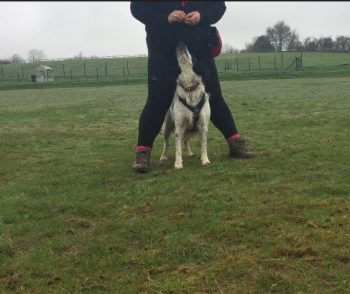
A couple of pictures of Maisie showing us a great ‘wait’ when she really wanted the liver cake I bought her for her first birthday! She sees this as high value so is showing us great control.
Have a try at home, it great fun watching your dogs reaction to different treats! Remember all dogs are different, so what is of high value to one dog, may not be to the next!
For a fab liver cake recipe, courtesy of Angela White, please check out my website training page https://www.carriescanines.co.uk/dog-training-coventry-kenilworth-warwick/
Carrie Stuthridge runs and owns Carrie’s Canines & Friends which provides Dog Adventures, Puppy & Dog Training School, Behaviour Consultations & Pet Care Services in Coventry.