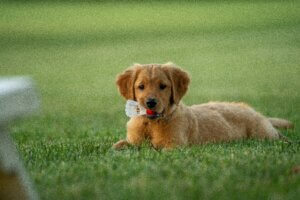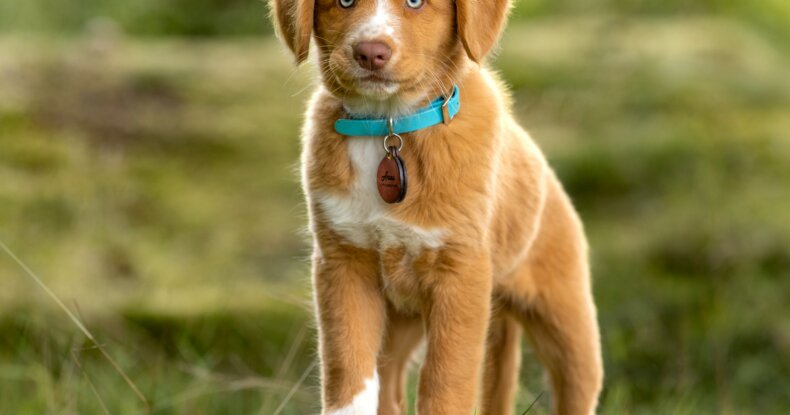
If your puppy won’t focus when you’re out and about, you’re not alone.
This is one of the most common concerns I hear from puppy owners. Puppies who stop, stare, fixate, ignore food, or seem completely absorbed in the world around them. Owners often worry that their puppy isn’t listening, isn’t engaged, or isn’t learning properly.
In reality, this behaviour is very often completely normal puppy development.
What it looks like when your puppy won’t focus
When owners say their puppy struggles to focus, they’re often describing things like:
- Stopping and staring at people or dogs
- Becoming fixated on something in the environment
- Not responding to their name
- Ignoring food they would normally take
- Losing interest in games or engagement
This isn’t usually a training issue. It’s much more often about arousal and emotional state.

Puppies are processing a brand-new world
For puppies, everything is new.
When a puppy stops and stares, they’re often:
- Gathering information
- Processing what they’re seeing
- Feeling curious
- Feeling uncertain
- Feeling excited
Sometimes it’s one of these. Sometimes it’s a mix of all of them.
This is why I spend so much time teaching owners to watch their puppy’s body language. Is the puppy curious? Overwhelmed? A little worried? Over-excited? The answer matters, because it tells us how to help.
This is a big part of what I teach inside my Dream Puppy Programme. Understanding why your puppy is behaving the way they are makes everything else easier.
Puppies need gradual, positive exposure to the world rather than being overwhelmed all at once, which is something Dogs Trust also highlight in their guidance on early experiences.
Dogs Trust also highlight in their guidance on early experiences
A real-life example
A client messaged me recently after a walk in the park with their puppy.
They explained that when someone walked past on the path, their puppy stopped and fixated. Treats were ignored, even though food usually works well. Sometimes a game helped, but they didn’t want to rely on that every time. The puppy would eventually lose interest and move on by themselves.
This is a really common scenario.
What was happening here wasn’t disobedience. It was high arousal.
This is very common when a puppy wont focus in busy or overwhelming environments.
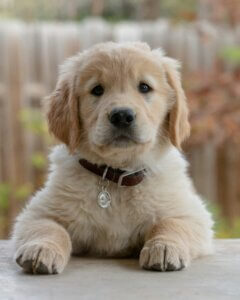
Arousal changes what your puppy can cope with
When a puppy’s arousal is high, they physically cannot take food or engage in the same way. It’s not a food problem. It’s not a motivation problem.
It’s an environment and arousal problem.
When arousal is too high, your puppy is no longer able to:
- Hear you properly
- Process information
- Take food
- Make good choices
What helps most in these moments is distance.
Why distance works so well
Distance lowers arousal.
The further your puppy is from a distraction, the more able they are to:
- Notice you
- Hear you
- Take food
- Re-engage
Once your puppy is back under threshold, meaning they can see, hear, and take food again, learning can happen.
From there, you practise reducing the distance gradually, bit by bit, at your puppy’s pace.
If your puppy can’t focus, the environment is simply too hard for them right now.
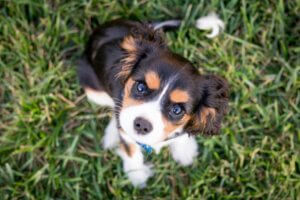
Busy environments are often too much, too soon
One of the biggest mistakes I see is taking puppies into very busy environments before they’re ready.
Busy parks, popular walking routes, lots of dogs and people. These environments can be incredibly overwhelming for young puppies.
Starting in low-distraction environments allows your puppy to learn how to focus on you before the world gets harder.
This isn’t about avoiding the world. It’s about introducing it thoughtfully.
Food and games are tools, not fixes
Games and food are incredibly useful tools. I often describe them as tools in your puppy-training toolbox.
But if food suddenly stops working, it’s important to understand why.
When food doesn’t work, it’s usually not because the food isn’t good enough. It’s because the puppy’s arousal is too high for learning to take place.
That’s your cue to:
- Increase distance
- Lower difficulty
- Support your puppy, not push them through it
Letting puppies observe is important
It’s also important to normalise that puppies sometimes just need to look.
Standing still and observing is part of how puppies learn about the world. Constantly interrupting or trying to distract them can actually increase frustration or arousal.
What we’re aiming for is:
- Allowing puppies to look
- Then reinforcing re-engagement
- Rewarding natural check-ins
This builds focus without pressure.
Focus isn’t eye contact
Focus doesn’t mean sustained eye contact or sitting still.
Focus is your puppy choosing you over the environment.
That choice develops over time, with experience, repetition, and thoughtful exposure.
With my own spaniel, I spent a lot of time teaching that the world was “none of her business”. Dogs, people, movement, all of it. Engagement with the environment happens on my terms, not by default.
That foundation makes everything else easier later on.
Why this matters long-term
Unmanaged arousal and fixation in puppies often shows up later as:
- Lead pulling
- Recall struggles
- Difficulty disengaging from distractions
At this age, we’re not fixing problems. We’re preventing them.
Building calm focus now means you don’t have to undo habits later.
A gentle next step
Supporting puppies through this stage is exactly what I do inside my Dream Puppy Programme.
We focus on:
- Understanding puppy behaviour
- Reading body language
- Managing arousal
- Building engagement and focus at the puppy’s pace
If you’d like support getting these foundations right now, you can find out more about the Dream Puppy Programme here: