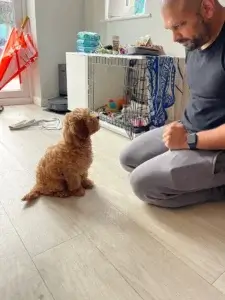
If you’re struggling with puppy focus and your puppy seems distracted or unable to concentrate, you’re not alone.
This is one of the most common worries I hear from puppy owners, especially in those early weeks and months. Puppies that flit from one thing to the next, seem distracted, lose interest quickly, or just don’t appear to be listening.
Here’s the reassurance most owners need to hear early on.
This behaviour is not a training failure. In most cases, it’s completely normal puppy development.

Why puppy focus is often misunderstood and What owners usually mean by “can’t focus”
When owners say their puppy can’t focus, they’re often describing things like:
- Getting distracted easily
- Struggling to engage during training
- Losing interest partway through a session
- Becoming silly, bitey, or overexcited
- Seeming to “switch off”
Very often, this isn’t about a lack of ability. It’s about capacity.
Puppies are dealing with a lot. Their brains are developing, their bodies are growing, and the world is full of new information. Add in tiredness, hunger, needing the toilet, or simply having had enough, and focus naturally drops.
Puppies have a much shorter learning window than we think
Young puppies can only concentrate for short periods of time. Once that window is full, it’s full.
You’ll often see this when a puppy starts a session well, does a few repetitions nicely, and then suddenly seems to struggle with something they were just doing. That’s not them being awkward. That’s their brain saying “I’ve had enough”.
This is especially common when:
- Sessions go on too long
- Too many repetitions are asked for
- New skills are practised without enough breaks
- Training happens when the puppy is already tired or overstimulated
At that point, pushing on doesn’t improve focus. It usually makes things worse.

Expectations are often the real problem
One of the biggest challenges for puppy owners today is expectation.
Social media, comparison with other dogs, and well-meaning advice can create the idea that puppies should be able to focus for longer than is realistic. Owners start to feel pressure when their puppy doesn’t seem to be keeping up.
But puppies learn at different rates.
In a class environment, it’s very common to see one puppy flying with loose lead walking one week while another struggles. The following week, those roles can completely reverse when it comes to recall or engagement. That’s normal learning, not a problem.
Progress with puppies is rarely linear.
Focus is not eye contact
This is an important distinction.
Focus does not mean sustained eye contact or sitting still in front of you.
Focus is your puppy choosing you over the environment.
That choice is influenced by:
- How interesting the environment is
- How tired your puppy is
- How enjoyable the interaction feels
- Whether the task is achievable at that moment
Expecting young puppies, especially spaniels, working breeds, and doodles, to offer stillness and long periods of concentration in exciting environments is often unrealistic.
Many of these dogs are built to move, explore, and use their senses. Asking for calm focus without building it gradually sets them up to struggle.
Why overtraining and repetition backfire
When puppies don’t appear to focus, owners often respond by doing more. Longer sessions. More repetitions. More asking.
Unfortunately, this usually has the opposite effect.
Too much repetition can quickly make training feel boring or frustrating, particularly for dogs who don’t enjoy doing the same thing over and over. Whippets are a great example. Ask them to repeat something several times in a row and they’re likely to walk off rather than engage.
Training should feel enjoyable. When it stops being fun, puppies stop wanting to take part.
Relationship before obedience
This is where early puppy work really matters.
Before worrying about how well your puppy can perform skills, it’s worth asking:
- Does my puppy enjoy interacting with me?
- Do they want to engage?
- Do they find me rewarding to be around?
Building a strong relationship and bond early on makes everything else easier. Puppies that enjoy spending time with their owners naturally offer more attention and engagement over time.
Play, fun interactions, and shared enjoyment are not “extra”. They are the foundation.
If you’re not exciting or rewarding to be around, it’s very hard for a puppy to choose you over the world.

What helps instead
Rather than drilling focus, it’s more helpful to think about:
- Encouraging natural check-ins
- Teaching puppies to disengage from the environment and re-engage with you
- Keeping sessions short and varied
- Mixing learning with play
- Allowing puppies to move rather than forcing stillness outdoors
For busy breeds like spaniels, encouraging movement, retrieves, and games that work with their instincts often builds better engagement than asking for lots of sits and downs in stimulating environments.
Those calmer behaviours come later, once the foundations are in place.
Why this matters long term
Anything a dog practises, they get better at.
If a puppy practises disengaging, checking in, and enjoying interaction with their owner, those habits grow. If a puppy practises ignoring, pulling, or being self-employed in busy environments, those habits grow instead.
This is often how early focus issues show up later as:
- Recall struggles
- Lead pulling
- Difficulty listening in stimulating environments
Getting this right early doesn’t mean perfection. It means giving your puppy the best possible foundations so you don’t end up trying to undo habits later on.

A real example
I’m currently working with Nigel, a young spaniel who is doing exactly what spaniels do best, nose down and fully immersed in the world.
Rather than fighting that, we’re working with it. We’re building engagement through retrieves, play, scent-based activities, and rewarding natural check-ins. His homework is focused on fun, achievable tasks at home, with new layers added gradually in future sessions.
By working with his instincts rather than against them, we’re building focus in a way that feels natural to him.
A gentle next step
Supporting puppies through these early stages is exactly what I do in my Dream Puppy Programme. We focus on building strong foundations, realistic expectations, and enjoyable training that supports both puppy development and owner confidence.
If you’d like support getting things right now, rather than fixing habits later, you can find out more about the Dream Puppy Programme here: