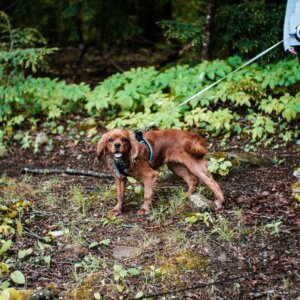
Track and Trail classes in Coventry are a fantastic way to give your dog the mental stimulation, confidence and purpose they crave. If your dog still seems full of energy after a long walk, you’re not alone.
If your dog still seems full of energy after a long walk, you’re not alone.
Many owners assume the answer is simply more exercise. Another walk. A longer walk. More ball throwing. More miles.
But what if your dog doesn’t need more exercise?
What if they need a job to do?
The Mistake Many Dog Owners Make
When we think about tiring our dogs out, we often focus on physical exercise.
The trouble is that many dogs, particularly Spaniels, Labradors, Doodles and other active breeds, were bred to use their brains as much as their bodies. This is why I consider natural instincts, motivation and breed traits within my breed-specific dog training.
Imagine spending an hour at the gym compared to spending an hour solving puzzles, learning a new skill or concentrating on a complex task. Both can be tiring, but in very different ways.
Dogs are no different.
Many dogs return from a long walk physically tired but mentally ready for more. This is why some dogs seem to have endless energy despite getting plenty of exercise.
Your Dog’s Most Powerful Tool
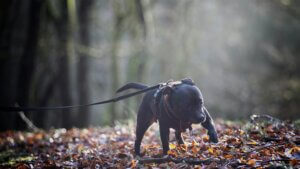
While we rely heavily on our eyesight, dogs experience much of the world through their nose.
A dog’s sense of smell is extraordinary.
Every lamppost, blade of grass and footpath contains information that we can’t even begin to imagine. Yet many owners spend a large part of their walks trying to stop their dog sniffing.
What if sniffing wasn’t the problem?
What if it was actually the solution?
Why Dogs Love Having a Job to Do
One of the reasons dogs thrive when given meaningful activities is that it allows them to express natural behaviours. Working with the individual dog and helping them use their natural abilities positively is an important part of my approach to dog training.
Tracking and trailing gives dogs exactly that opportunity.
Instead of wandering around searching for things to sniff, your dog is given a clear purpose. They follow a scent trail, solve a problem and work towards a goal.
The result is often a dog who is focused, engaged and genuinely fulfilled.
Many owners are surprised by how mentally tiring tracking can be. A relatively short tracking session can leave a dog feeling far more satisfied than a much longer walk. This is also a useful reminder that effective training does not always require long sessions, as I explain in my guide to staying consistent with dog training.
You’ll See Your Dog Differently
One of the things I love most about tracking and trailing is what happens to the owners.
Most of the time we’re teaching our dogs. We guide them, help them and show them what to do.
Tracking turns that completely on its head.
Suddenly, your dog becomes the expert.
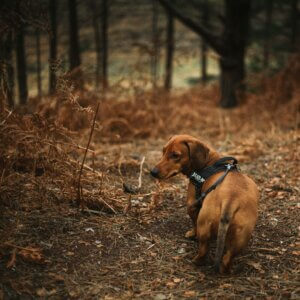
As they follow a scent trail across real terrain, making decisions and solving problems independently, you get to see just how incredible they really are.
Owners often light up when they realise what their dog is capable of without any help from them.
You start to notice the tiny changes in body language. The moment your dog finds the scent. The concentration. The determination. The problem-solving.
It creates a completely different appreciation for your dog and often strengthens the relationship between you in ways people don’t expect.
Rather than constantly directing your dog, you learn to trust them.
And that trust builds a wonderful partnership.
Why Reactive Dogs Often Love Tracking
Many reactive dogs spend their walks scanning the environment.
They’re watching other dogs, people, cyclists or anything else they find exciting, frustrating or worrying.
Tracking gives them a different focus.
Instead of concentrating on everything happening around them, they have a clear job right in front of them.
Because dogs work individually, there is no pressure to interact closely with other dogs while they’re working.
For many reactive dogs, tracking can be a fantastic confidence-building activity that allows them to engage with the environment in a calmer and more productive way. If your dog regularly barks, lunges or struggles around other dogs or people, you can also learn more about my reactive dog training in Coventry.

Why I’m So Excited About Track and Trail
I’ve been fascinated by tracking for years.
Watching a dog follow an invisible scent trail using nothing but their nose is incredible. It never stops amazing me what dogs are capable of when we give them the opportunity to use their natural abilities.
There is even specialist training available where dogs help locate lost dogs, something I’ve been interested in for a long time. A dog trainer friend recently completed this training and hearing about the process has only increased my enthusiasm for scent-based work.
Unfortunately, with Envy’s recovery this year, the timing hasn’t been quite right for me to explore that route myself yet.
But my passion for tracking has continued to grow, which is why I’m so excited to finally bring Track & Trail classes to local dog owners.
Want to learn more about my experience – have a read here About Me
Introducing Track & Trail Classes in Coventry
This July I’m launching brand-new Track & Trail Introduction Courses for dogs and their owners across Coventry, Kenilworth and Leamington Spa. You can view the locations I cover on my Areas I Serve page.
The four-week introduction course is designed specifically for beginners.
No previous experience is needed.
You’ll learn:
- How scent trails work
- How to read your dog’s body language
- How to handle a tracking line safely
- How to support your dog without interfering
- How to build confidence and focus through tracking
Once you’ve completed the introduction course, you’ll be able to continue developing your skills through ongoing Track & Trail sessions.
Could Your Dog Benefit From Having a Job To Do?
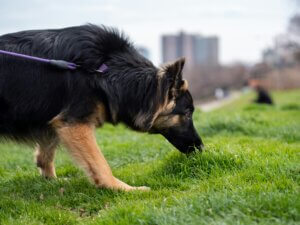
If your dog loves sniffing, struggles to switch off, enjoys problem-solving, or you’re simply looking for something different to enjoy together, Track & Trail could be exactly what you’ve been looking for.
Your dog was born with an incredible nose.
Maybe it’s time to give them the chance to use it.
Ready to Get Started?
Places on my Track & Trail Introduction Courses are limited so that each dog and owner receives plenty of guidance and support.
The first Track & Trail courses start this July and places are intentionally limited to keep group sizes small.
If you’d like to give your dog a new challenge and discover what they’re truly capable of, now is the perfect time to get started.
I’d love to show you just what your dog is capable of.