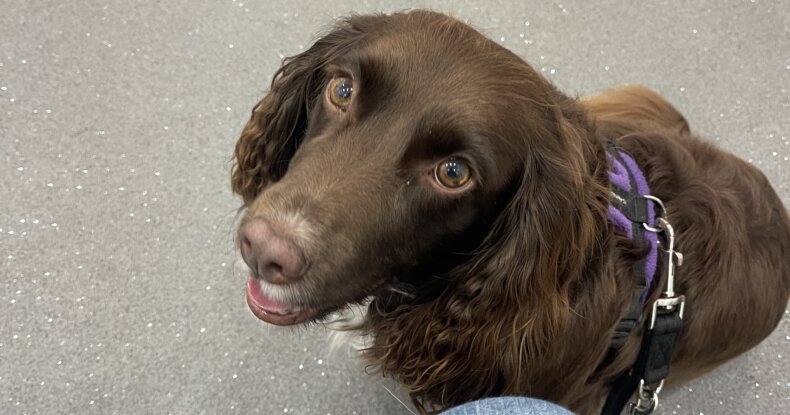
This week my dog Envy had the first stage of stem cell therapy, and I thought it might be helpful to share why I decided to go down this route and what the process actually involves.
Stem cell therapy for dogs is still relatively new in veterinary medicine, and many dog owners haven’t heard much about it yet. So I wanted to explain what it is, why we chose it, and what the journey has looked like so far.
How This Journey Actually Started
Interestingly, this all started with behaviour rather than an obvious injury.
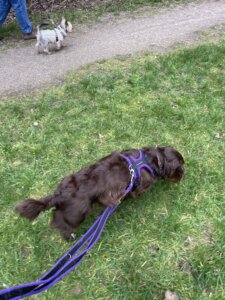
Envy has always struggled with roads. When we were near traffic she would flatten herself to the ground, her tail tucked right underneath her. She couldn’t take food, couldn’t hear me, and it looked very much like fear.
We had made progress with training, but we’d reached a point where I felt stuck. I was even starting to think about anxiety medication.
Then something hit me like a bus.
If this had been a client dog, the first thing I would have done was consider whether pain could be involved.
Pain can show up in behaviour in ways that aren’t always obvious. So instead of continuing down the behaviour route alone, we started investigating whether there might be a physical reason behind what we were seeing.
That decision changed everything.

The Diagnosis
After referral and further investigation, Envy had CT scans and further orthopaedic assessment.
Those scans confirmed she has:
• hip dysplasia in both hips
• arthritis in both hips
Hip dysplasia is a developmental condition where the hip joint doesn’t form properly. Over time that instability can lead to inflammation and arthritis within the joint.
Once arthritis develops, the goal becomes managing pain, slowing the progression of the disease and helping the dog remain comfortable and active.
It’s also worth mentioning that hip dysplasia isn’t something we typically associate with Spaniels.
In fact, in Spaniels we more commonly see elbow dysplasia. So discovering that Envy had hip dysplasia in both hips wasn’t something I had necessarily expected.
It’s a good reminder that while breed tendencies exist, every dog is still an individual.
The Treatments We Tried First
Stem cell therapy wasn’t the first step.
Before reaching this point we had already tried several treatments to support Envy’s joints and manage inflammation.
These included:
• PRP (platelet-rich plasma) treatment at Christmas
• Cartrophen injections
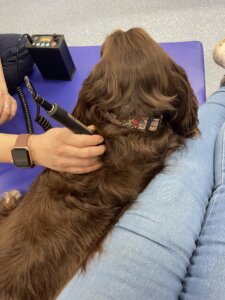
• physiotherapy with red light therapy
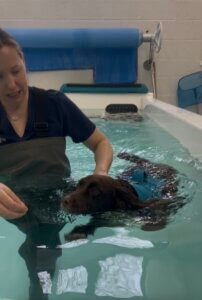
• hydrotherapy swimming sessions
• Previcox, an anti-inflammatory medication
• Amantadine, which helps with how the brain processes chronic pain signals
All of these treatments aim to reduce inflammation, improve mobility and support joint health.
And importantly, they have helped.
Recently on a Bank Holiday walk I tried something that previously would have been impossible. Envy walked along the road without that same level of panic. She could hear me again and she could take food.
For the first time in a long time, I felt like we were starting to turn a corner.
How Pain Can Affect Behaviour
One of the reasons I wanted to share this story is because pain and behaviour are often connected.
Dogs are incredibly stoic animals. They often mask pain extremely well, and it doesn’t always show up as obvious limping or injury.
Sometimes pain shows up as behaviour changes instead.
For example:
• reluctance to walk in certain environments
• sudden sensitivity to surfaces or movement
• difficulty concentrating or taking food
• increased anxiety or stress responses
What we sometimes assume is a training problem can actually be linked to discomfort.
Until the pain is addressed and the dog feels physically more comfortable, it can be very difficult to resolve the behaviour side fully.
What Stem Cell Therapy for Dogs Actually Is
Stem cell therapy for dogs is part of a newer area of veterinary medicine known as regenerative therapy.
In dogs, the treatment usually involves collecting a small sample of fat tissue from the dog’s body. Fat contains special cells called mesenchymal stem cells, which have the ability to help regulate inflammation and support tissue repair.
The process generally works like this:
- A small fat sample is taken under general anaesthetic
- The sample is sent to a laboratory
- The lab isolates and prepares the stem cells
- Those cells are injected back into the affected joints
Because the cells come from the dog’s own body, the risk of rejection is very low.
The aim is to reduce inflammation in the joints and improve mobility and comfort over time.

The First Stage of Envy’s Treatment
Envy had the first stage of the treatment this week at MediVet Leamington Spa.
This procedure involved a general anaesthetic and a small surgical incision along her tummy to collect a sample of fat tissue.
Those fat cells are now being sent to a specialist laboratory where the stem cells will be isolated and prepared.
The cost of this first stage was around £850.
In approximately four weeks, those processed stem cells will be returned to the vet and injected directly into Envy’s hip joints.
The second stage of the treatment is expected to cost around £2,000.
It’s not a small investment, but for us it felt like the right option to explore.
Recovery From the First Procedure
At the moment Envy is recovering from the fat collection procedure.
She has a small incision on her tummy, so for now she is on strict rest.
Her recovery plan currently looks like this:
• three days rest at home and in the garden
• a check-up with the vet after three days
• lead walks only for two weeks
• stitches removed after two weeks
After that we’ll prepare for the second stage when the stem cells are injected into her hip joints.
Once she’s recovered from that stage, she will gradually return to her normal rehabilitation routine.
Rehabilitation Will Still Continue
It’s important to say that stem cell therapy isn’t a magic fix.
Managing joint disease is always about supporting the dog in multiple ways.
Envy will still continue with:
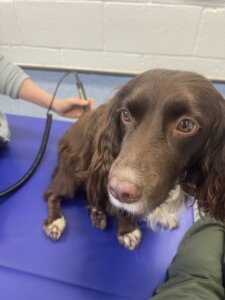
• physiotherapy
• red light therapy
• controlled exercise
• hydrotherapy swimming sessions
All of these work together to support joint health, muscle strength and long-term mobility.
Envy will also continue with her physiotherapy sessions with Becky, who has been helping us manage her recovery with red light therapy and tailored rehabilitation exercises.
Having the right physio support has made a huge difference in keeping her comfortable and improving her movement.
Here is Rebecca’s Facebook page – https://www.facebook.com/share/1YUCgExg1j/?mibextid=wwXIfr
What I’m Hoping For
My biggest reason for exploring stem cell therapy is Envy’s age.
She’s only five years old.
If this treatment can reduce inflammation and help her joints remain comfortable, there is a possibility that we can reduce her reliance on long-term medication.
Ultimately my goal is simple.
I want her to live a comfortable, active life for as long as possible.
And personally, I would love for her to feel relaxed walking in places where roads are unavoidable.
We don’t do lots of road walking day to day, but when we visit places like the Peak District or small villages, you inevitably have to cross roads.
My hope is that as her hips feel more comfortable, those situations will become easier for her too.
I’ll Share How She Gets On
Because stem cell therapy is still quite new in veterinary medicine, I know many owners are curious about how effective it is.
So I’ll share an update in a few weeks once Envy has had the joint injections and we can see how she responds.
If it helps other dog owners understand the options available for arthritis and hip dysplasia, then it’s worth sharing.
Treatment Options for Hip Dysplasia and Arthritis in Dogs
When a dog is diagnosed with hip dysplasia or arthritis, stem cell therapy is just one of several options available.
Most dogs will benefit from a combination of treatments rather than relying on just one approach.
Some of the most common options include:
Medication
Anti-inflammatory medications like Previcox can help reduce pain and inflammation. Medications such as Amantadine can also support how the brain processes chronic pain.
Joint support injections
Treatments like Cartrophen are often used to support joint health and mobility over time.
Physiotherapy and rehabilitation
Working with a qualified physio can make a huge difference. Treatments such as red light therapy, targeted exercises and mobility work help improve strength and comfort.
Hydrotherapy
Swimming allows dogs to build muscle and improve joint movement without putting pressure on the joints.
PRP (Platelet-Rich Plasma)
This uses the dog’s own blood components to help support healing and reduce inflammation within the joint.
Weight management and lifestyle adjustments
Keeping dogs at a healthy weight and managing exercise appropriately is one of the most important long-term factors.
Surgery (in more severe cases)
In some situations, surgical options such as hip replacements may be recommended.
Stem cell therapy sits within this wider picture as another option that may help reduce inflammation and improve comfort, particularly when used alongside a structured rehabilitation plan.
More Reading
Here are a couple of links for you to read more on this
Stem Cell Therapy Guide
https://www.fitzpatrickreferrals.co.uk/orthopaedics/stem-cell-therapy
Hip Dysplasia in Dogs (PDSA)
https://www.pdsa.org.uk/pet-help-and-advice/pet-health-hub/conditions/hip-dysplasia-in-dogs