If your dog doesn’t pay attention on walks, you’re definitely not alone.
A really common thing I hear from owners is:
“He just does his own thing.”
Or:
“I feel like he’s taking me for a walk.”
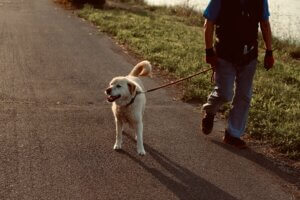
Your dog is busy sniffing, scanning the environment, watching other dogs or pulling ahead, and it feels like you’re just following along behind them.
When you try to get their attention, they seem far more interested in everything else going on around them.
It can feel frustrating, especially when you see other dogs walking calmly next to their owners.
But in most cases, this isn’t because your dog is stubborn or deliberately ignoring you.
It’s usually because your dog has simply never learnt that checking in with you is valuable.
What It Looks Like When Dogs Don’t Check In
Dogs that don’t check in with their owners often show behaviours like:
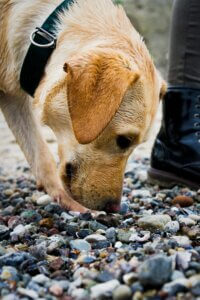
- Nose constantly down on scent
- Scanning the environment instead of looking at the owner
- Pulling ahead on the lead
- Ignoring the owner unless they are called
- Being far more interested in dogs, people or smells
Owners often say their dog is “too distracted”.
But what’s usually happening is that the dog has learnt the environment is more interesting than their owner.
This is very similar to the issue I explained in my blog about why your dog only comes back when they feel like it, where recall becomes optional once distractions appear.
How This Often Starts
This pattern often begins when dogs are young.
Many owners are told to “socialise their puppy”.
So the puppy is allowed to greet every dog and every person they see.
They learn very quickly that other dogs and people are exciting and accessible.
Meanwhile, very little reinforcement happens for staying close to the owner.
So the dog learns that the real fun is out in the environment, not with the person holding the lead.
Too Much Freedom Too Early
Another common reason dogs stop checking in is too much freedom too soon.
A young dog may be given lots of off-lead freedom before they have learnt engagement skills.
They spend walks:
- following scents
- exploring the environment
- watching other dogs
All of which are naturally rewarding for them.
Over time they become what I often call self-employed.
They are happily entertaining themselves without needing their owner at all.
Calling Your Dog Instead of Reinforcing Check-Ins
Owners often respond to this by calling their dog constantly.
But there’s a better approach.
Instead of waiting until your dog has completely disengaged and then calling them, it’s far more effective to reinforce the moments when they choose you naturally.
For example:
Your dog glances back at you.
That’s a check-in.
Reward it.
Those small moments build the habit of your dog looking to you for information.
Teaching Dogs That the Party Is With You
One of the things I often say to owners is:
“The party needs to be with you.”
If all the exciting things on a walk are happening out in the environment, your dog has no reason to pay attention to you.
But if engagement with you leads to rewards, games, interaction and movement, suddenly you become interesting.
This doesn’t mean constantly feeding treats.
It means creating interaction.
Talking to your dog, changing direction, playing little engagement games and reinforcing those natural check-ins.
Environment and Distractions Matter
Another important factor is the environment you are training in.
Many owners expect their dog to focus in busy parks straight away.
But environments have different levels of difficulty.
For example:
- your home
- your garden
- quiet streets
- quiet parks
- busy parks with lots of dogs
Places like the War Memorial Park in Coventry can be a level ten environment for a dog.
If your dog hasn’t learnt to check in with you in easier environments first, that level of distraction will simply be too much.
This is why gradually layering environments and distractions makes such a big difference.
What Good Engagement Looks Like
When engagement improves, walks start to feel very different.
Instead of constantly watching your dog, you begin to notice them checking in with you.
They glance back.
They slow down to stay near you.
They choose to hang out with you even though the environment is still interesting.
That connection makes everything else easier too.
Recall improves.
Lead walking improves.
And your dog becomes much easier to guide through different environments.
If Your Dog Doesn’t Pay Attention on Walks
The good news is this is something that can absolutely be taught.
Dogs naturally learn from what works for them, so when we start reinforcing engagement and building it gradually in different environments, the habit of checking in begins to grow.
This is something I help owners work on step by step inside my Dream Dog Programme.
Because when your dog learns that the party is with you, walks become far more enjoyable for both of you.
Modern dog training focuses on reward-based training methods, which help dogs learn through positive associations rather than pressure.