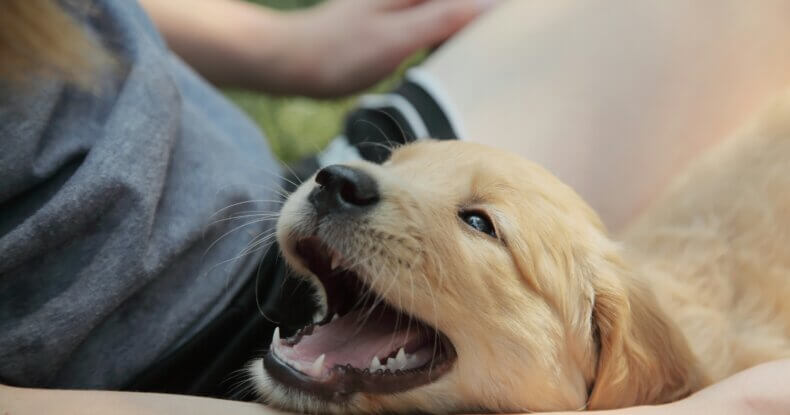
Why does my puppy bite more at certain times of the day? If your puppy seems to turn into a completely different dog when they’re tired, there’s a very good reason for it.
One minute they’re happily pottering around, playing or snoozing.
The next, they’re grabbing your trousers, biting your hands, launching themselves at you, racing around the room and seemingly forgetting everything you’ve been teaching them.
It can feel as though your puppy has suddenly become incredibly naughty.
But very often, they aren’t being naughty at all.
They’re overtired.
An overtired puppy can look remarkably similar to an overtired child who desperately needs a nap but somehow becomes louder, sillier and harder to settle instead.
And because puppies don’t necessarily recognise that they need to stop, sleep and reset, it’s often up to us to help them.
Why Do Puppies Bite More When They’re Tired?
Puppy biting is completely normal. Blue Cross also have an article on this here
Puppies explore with their mouths, play with their mouths and, while they’re teething, chewing can also help relieve discomfort.
But you may notice that the biting becomes much more intense when your puppy is tired.
They may:
- Bite harder than usual.
- Grab at clothing.
- Chase your feet or ankles.
- Jump up repeatedly.
- Become increasingly frantic during play.
- Stop responding to things they normally understand.
- Race around the house.
- Struggle to settle even though they clearly need to.
This is where tiredness and arousal start feeding into one another.
Your puppy becomes tired, but instead of simply lying down and going to sleep, they become more stimulated.
The more stimulated they become, the harder it becomes for them to switch off.
And the harder it becomes to switch off, the more wild their behaviour can become.
The Overtired Puppy Cycle
I often think of this like a toddler who has missed their afternoon nap.
You might expect a tired child to become quiet and sleepy.
Anyone who has spent time around overtired children knows that isn’t necessarily what happens.
They can become emotional, silly, hyperactive and far less able to cope with anything going wrong.
Puppies can be very similar.
Their behaviour might look like:
Tired → over-aroused → biting → more interaction → even more aroused → unable to settle.
And this is where owners can accidentally get caught in a cycle.
The puppy starts biting.
So you play with them to distract them.
They become even more excited.
They bite harder.
You try another game.
Now they’re racing around the house.
Eventually everyone is exhausted and frustrated.
But what the puppy actually needed twenty minutes ago was sleep.
How Much Sleep Does a Puppy Need?
One of the things that surprises many new puppy owners is just how much sleep puppies need.
Young puppies can spend a huge proportion of their day asleep.
They’re growing physically, but their brains are also processing an enormous amount of new information.
Think about what happens when a puppy first comes home.
Everything is new.
Their house.
Their family.
The garden.
Traffic.
Visitors.
Other dogs.
Sounds.
Smells.
Training.
Handling.
Learning where to toilet.
Learning where to sleep.
Learning what they’re allowed to chew.
Learning how life works.
That’s a lot for a developing brain.
Sleep gives them the opportunity to process all of this.
So if your puppy has been awake for a long period and their behaviour suddenly deteriorates, tiredness should absolutely be one of the things you consider.

Normal Puppy Biting or Overtired Biting?
This is an important distinction.
Normal puppy mouthing often happens during play, exploration and social interaction.
Overtired biting tends to feel different.
It often becomes faster, harder and much more frantic.
Your puppy may seem unable to disengage.
You redirect them onto a toy, but two seconds later they’re back on your sleeve.
You ask for something they normally know and they appear incapable of concentrating.
They may start zooming around, barking or grabbing absolutely anything within reach.
That’s often the point where continuing to train isn’t particularly productive.
Their brain is telling you:
I’ve had enough.
Signs Your Puppy Might Need a Nap
Biting isn’t the only sign.
You may notice your puppy:
- Suddenly becoming much more excitable.
- Losing concentration.
- Zooming around the room.
- Barking for attention.
- Becoming increasingly mouthy.
- Grabbing furniture or clothing.
- Struggling to respond to familiar cues.
- Moving constantly from one thing to another.
- Seeming unable to settle themselves.
Some puppies become obviously sleepy.
Others become absolute chaos.
Learning what your puppy looks like when they’re reaching the end of their coping capacity is incredibly useful.
Once you recognise those early signs, you can help them settle before they reach full crocodile mode.
Why More Exercise Can Make Puppy Biting Worse
This is a really common mistake.
Your puppy is going wild, so it seems logical to think:
“They’ve got too much energy. I’ll tire them out.”
So you play more.
Walk further.
Throw toys.
Encourage another game.
But if your puppy is already overstimulated, adding more stimulation can make things worse.
You aren’t necessarily dealing with unused physical energy.
You may be dealing with a puppy whose nervous system desperately needs an opportunity to come back down.
This is why good puppy care isn’t just about providing enough activity.
It’s also about providing enough recovery from activity.
Helping Your Puppy Learn to Switch Off
Some puppies naturally settle quite easily.
Others need much more help.
And learning to relax is a skill in itself.
One thing I talk about with puppy owners is creating an off switch.
Your puppy shouldn’t need entertainment every waking minute.
They need opportunities to experience activity, play, training and socialisation, but they also need to learn that sometimes nothing is happening.
That might mean:
- Settling in their crate or sleeping area.
- Having a chew.
- Lying quietly while you work.
- Having calm time after a walk.
- Taking regular naps throughout the day.
The aim isn’t to force your puppy to sleep.
It’s to create an environment where sleep becomes the easiest and most natural option.
A Good Puppy Routine Makes a Huge Difference
Puppies generally cope better when their day has some predictability.
That doesn’t mean you need a military timetable.
But thinking in cycles can be really helpful.
For example:
Wake → toilet → food/play/training → toilet → calm time → sleep.
Then repeat.
The exact timings will depend on your puppy, their age and your household.
What’s important is that activity is regularly followed by rest.
If your puppy has spent the morning meeting people, going somewhere new, doing training and playing, they probably don’t need another exciting activity immediately afterwards.
They may simply need to sleep.
A Recent Example
I saw this really clearly with a puppy I worked with recently.
During our first session, we looked at his whole day rather than focusing purely on the biting. One of the things we realised was that he simply wasn’t getting enough sleep.
We also looked at his food and checked how much he should actually be eating. His owners increased both his opportunities to sleep and the amount he was being fed.
The difference when I saw him again a week later was huge.
He’d gone from being a little puppy land shark who was incredibly bitey and difficult to redirect, to a puppy who was much more content and able to settle.
We hadn’t found some magical training technique.
We’d looked at what the puppy actually needed.
And I think that’s such an important point. When we’re struggling with puppy behaviour, it’s very easy to focus entirely on how to stop the behaviour.
Sometimes we need to look underneath it first.
Is this puppy tired? Are they hungry? Are they overstimulated? Are their basic needs actually being met?
Training matters, of course. But it’s much harder for a tired, hungry or overwhelmed puppy to make good choices.

What Owners Often Do That Accidentally Makes Things Worse
Nobody deliberately makes their puppy more tired and bitey, but there are a few very common traps.
Constant entertainment
It’s tempting to feel that your puppy must be doing something whenever they’re awake.
But puppies also need to learn how to exist without constant input from us.
Too much exciting play
High-energy play isn’t bad, but it increases arousal.
If your puppy is already struggling to regulate themselves, another game of chase may not be what they need.
Waiting until they’re completely exhausted
It’s much easier to help a puppy settle when they’re beginning to get tired than when they’re already bouncing off the walls.
Trying to train through it
There comes a point where your puppy simply doesn’t have the brain capacity to concentrate.
That’s not stubbornness.
It’s information.
Assuming biting always means they need more exercise
Sometimes your puppy really does need activity.
Sometimes they need the exact opposite.
The skill is learning to tell the difference.
What Should You Do When Your Puppy Starts Biting Because They’re Tired?
First, reduce the stimulation.
You don’t need to turn it into a battle.
Keep things calm and boring.
Take them outside for a toilet break if needed, then help them move into their usual resting space.
You might offer an appropriate chew or something calm to lick if that helps them settle.
Lower the activity around them.
Then give them the opportunity to sleep.
If your puppy is already extremely over-aroused, they may need a little time to come back down before they can actually fall asleep.
That’s completely normal.
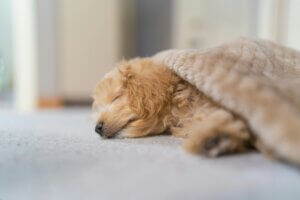
Don’t Wait Until the Biting Starts
This is probably one of the biggest things I’d encourage puppy owners to think about.
Rather than waiting for the 8pm crocodile to appear every night, start looking at what happens before it.
How long has your puppy been awake?
What have they done that day?
Have they been somewhere new?
Had visitors?
Done a training session?
Played with another dog?
Gone on a walk?
Had lots of excitement?
When you start recognising the pattern, you can often get ahead of the behaviour.
Maybe your puppy needs a nap at 6.30pm rather than waiting until they’re hanging from your dressing gown at 7.15pm.
Prevention is usually much easier than trying to calm an already exhausted puppy.
Your Puppy Isn’t Giving You a Hard Time
One of the biggest shifts I want puppy owners to make is moving away from thinking:
“Why is my puppy behaving like this?” or “My puppy hates me”
and towards:
“What does my puppy need right now?”
The biting is communication.
The zoomies are information.
The sudden inability to listen is information.
Your puppy isn’t deliberately trying to make your evening difficult.
They’re a young dog with a developing brain who hasn’t yet learned how to regulate themselves.
And sometimes, what they need most is simply help switching off.
Struggling With Puppy Biting, Sleep or Routine?
Bringing home a puppy can be wonderful.
It can also be exhausting.
And one of the hardest parts is working out whether your puppy needs more training, more enrichment, more sleep, less stimulation, or simply a different routine.
This is exactly the kind of thing I work through with owners on my 121 Puppy Training and Dream Puppy Programme.
Rather than giving you a generic timetable, we look at your individual puppy, your household and the behaviour you’re seeing, then build a routine and training plan that actually works for your life.
If biting is the main thing you’re struggling with, you may also find my guide Why Is My Puppy Biting Me So Much?helpful, where I look more broadly at normal puppy mouthing, teething and how to respond.
And if your puppy is approaching adolescence and suddenly seems to have forgotten everything you’ve taught them, I’ve also written about why the teenage stage can feel so chaotic.
Why The Teenage Years Feel so Chaotic
Final Thoughts
If your puppy suddenly turns into a land shark every evening, don’t automatically assume they need another walk or more play.
Look at the whole picture.
How long have they been awake?
How stimulating has their day been?
When did they last properly sleep?
Sometimes the puppy who seems to have endless energy is actually the puppy who desperately needs a nap.
And once you start recognising those signs earlier, evenings often become a lot easier for both of you.