Hip dysplasia treatment for dogs has come a long way in recent years, with options ranging from pain management and physiotherapy through to surgery and stem cell therapy.
Over the past four weeks, I’ve been documenting Envy’s recovery following stem cell treatment for bilateral hip dysplasia.
Some of the lessons have surprised me, particularly how important her previous training has been throughout the recovery process. Building confidence, trust and practical life skills is central to my approach to dog training, and this experience has shown me how valuable those foundations can become.
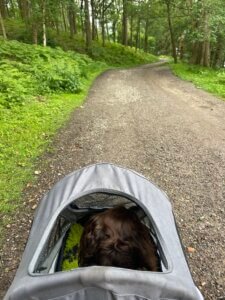
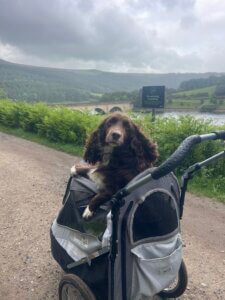
At the weekend, I found myself standing beside Ladybower Reservoir with a dog buggy.
If you’d told me a year ago that I’d be pushing my five-year-old Working Cocker Spaniel around a reservoir in a buggy, I’d have laughed.
Yet there I was.
And surprisingly, so was Envy.
Quite happily.
At least most of the time.
The reality is that when you have a dog with hip dysplasia, sometimes life looks a little different to how you imagined it would.
This is an update on Envy’s stem cell recovery journey so far, what I’ve learned during the first four weeks, and why the training you do long before you need it can make a huge difference when life suddenly changes.
Envy’s Hip Dysplasia Diagnosis
Envy was diagnosed with bilateral hip dysplasia and arthritis in both hips.
One hip is worse than the other, but both are affected.
Like many dogs with hip dysplasia, she isn’t an obvious case.
She still runs.
She still plays.
She still jumps into the van.
She still wants to be involved in everything.
In fact, if you met her, you probably wouldn’t think there was anything wrong.
That’s one of the reasons hip dysplasia and arthritis can be so difficult to recognise.
Dogs are incredibly stoic.
Many become experts at carrying on despite discomfort.
Why We Chose Stem Cell Therapy
At just five years old, I felt she was far too young to simply accept a future of increasing medication and reduced mobility.
My hope with stem cell therapy is simple.
I’d love to reduce her discomfort, improve her long-term mobility and, if possible, reduce her reliance on medication in the future.
At the moment, she’s still taking Previcox and Amantadine.
Ideally, I’d like to reduce or remove these if her comfort levels allow.
Of course, only time will tell whether that becomes possible.
On 21st May, Envy underwent stem cell treatment, with injections placed into both hips.
During the harvesting procedure, the vets were able to collect enough cells for several future treatments, which is reassuring as hip dysplasia is a lifelong condition that will need ongoing management.
Choosing the right hip dysplasia treatment for dogs depends on the individual dog, their age, lifestyle, severity of symptoms and long-term goals.
For some dogs, stem cell therapy can be an effective hip dysplasia treatment for dogs, helping to improve comfort, mobility and quality of life while potentially reducing the need for more invasive procedures.
The Cost of Hip Dysplasia Treatment
One thing I think is important to talk about is cost.
So far, Envy’s treatment has cost over £3,000.
That figure includes the harvesting procedure, stem cell injections and ongoing rehabilitation support.
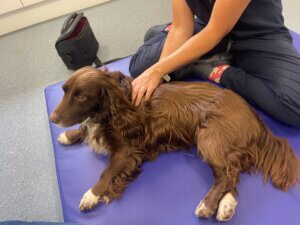
She’s also receiving physiotherapy and red light therapy to support her recovery.
Thankfully, Envy is insured with Petplan.
Before moving forward, we made sure everything was approved and covered under her policy.
Having good insurance removed a huge amount of stress from the decision-making process.
Instead of worrying about whether I could afford treatment, I could focus on choosing what I felt was best for her long-term welfare.
For me, this isn’t just a financial decision.
It’s an investment in the rest of her life.
If you’re considering treatment options, the team at Petplan provide useful information about hip dysplasia, treatment options and long-term management.
Recovery Has Been Slower Than I Expected
If I’m completely honest, I expected recovery to move a little faster.
I thought we’d be back to longer off-lead adventures sooner.
I thought I’d see obvious improvements more quickly.
Instead, recovery has required far more patience than I anticipated.
As I write this, we’re approaching week four.
The veterinary guidance suggested improvements often become noticeable somewhere between four and six weeks after treatment.
That timing is important because until recently, I wasn’t sure I was seeing much change at all.
The Challenge of a Subtle Dog
One thing I’ve learned is that Envy is incredibly difficult to read.
Even her physiotherapist has commented on how subtle she is.
She doesn’t scream when she’s uncomfortable.
She doesn’t stop doing things.
She doesn’t dramatically limp around.
Instead, she gives tiny clues.
A lip lick.
A yawn.
A slight shift of her body.
A reluctance to stay still.
A wider eye.
A change in how relaxed she looks.
At physio, if something feels uncomfortable, she might simply move herself a few inches away.
If a particular area is sensitive, she’ll quietly reposition herself until she’s comfortable again.
These are easy signs to miss if you’re not looking for them.
It’s one of the reasons I think so many owners underestimate how uncomfortable their dogs may be.
The Dog Buggy I Never Expected to Use
One challenge during recovery has been balancing exercise restrictions with quality of life.
For the first two weeks, Envy’s exercise was heavily restricted.
After that, she was allowed short periods off lead, which we’ve gradually been building up.
The problem is that Envy still wants to come on adventures.
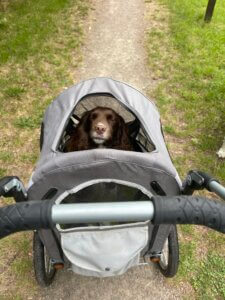
That’s where the buggy came in.
Before using it, I introduced it gradually.
First with no wheels.
Then with wheels.
Then rolling around the garden.
Then short local walks where she could hop in and out.
She accepted all of it brilliantly.
When we reached Ladybower Reservoir, however, things became a little harder.
The walk started near a busy road, which she finds challenging anyway.
She struggled to settle initially.
And honestly, I don’t blame her.
Normally she’d be exploring.
Sniffing.
Walking.
Being a spaniel.
Those natural instincts and breed traits are something I consider within my breed-specific dog training, because training should work with the individual dog rather than against who they are.
Instead she was being pushed around in a buggy.
It’s a very strange experience when you’ve never done it before.
Once we moved away from the road and into a quieter area, she settled much more comfortably.
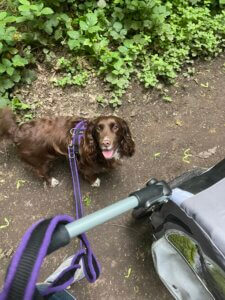
Part way through the walk, I let her out for a stretch and some gentle lead walking.
Later, something interesting happened.
I offered her the opportunity to stay out.
Instead, she chose to get back into the buggy.
That moment reassured me more than anything else.
Perhaps she wasn’t just tolerating it.
Perhaps she was finding it genuinely helpful.
Why Foundation Training Matters More Than You Think
One of the biggest lessons from this whole experience has been the value of foundation training. Through my one-to-one dog training in Coventry, I help owners build practical skills, confidence and communication that can support their dogs throughout everyday life.I never specifically trained Envy to ride in a dog buggy.
That wasn’t on my training plan.
But over the years we’ve worked on:
- Confidence
- Trust
- Engagement
- Trying new things
- Handling
- Cooperative care
- Problem solving
All of those skills made this transition easier.
When life suddenly changed, she already had the foundations to cope with something new.
It’s a reminder that training isn’t just about recall or lead walking.
The skills we teach our dogs today often pay off months or even years later in ways we never expect. This is why building confidence, handling skills and positive habits is such an important part of my one-to-one puppy training in Coventry.The foundations we build in everyday life often pay off later. I wrote more about this in my blog on staying consistent with dog training.
What I’m Starting to See Now
Over the last few days, I think I’m beginning to see small changes.
Nothing dramatic.
Nothing life-changing overnight.
But subtle improvements.
She seems brighter.
More enthusiastic.
More eager to be off lead.
More animated on walks.
She appears more comfortable in herself.
For another dog owner, these changes might sound insignificant.
For a dog as subtle as Envy, they’re actually quite meaningful.
What Happens Next?
For now, recovery continues.
We’re gradually increasing off-lead time.
We’re continuing with physiotherapy.
We’re monitoring comfort levels carefully.
And we’re trying not to rush the process.
The stem cells that were harvested should provide options for future treatments if needed, but right now the focus is simply allowing this first treatment the time it needs to work.
While I’m still early in this journey with Envy, stem cell therapy has been an interesting hip dysplasia treatment for dogs and I’m hopeful it will help improve her comfort and mobility over the coming months.
The Biggest Lesson So Far
If there’s one thing this journey has taught me so far, it’s this:
Recovery takes patience.
Dogs are often far more subtle than we realise.
And the training you do today often pays off years later when you need it most.
Whether that’s teaching a recall, helping a dog feel confident around new experiences or building trust through everyday interactions, those foundations matter.
Because one day life might throw something unexpected at you.
And when it does, you’ll be grateful for every bit of training you’ve already put in.